

Creating Reading Nooks
Megan Daley on why young readers need cosy spaces at home and at school – and how to create them

There is something undeniably enticing about a reading nook — a little corner dedicated to quiet moments with a good book. Whether it’s tucked under the stairs or under a couch (quite a popular spot in my school library), or in the corner of a classroom, creating a cosy reading space invites children to slow down and spend time with a book.
Reading nooks signal to children that reading quietly and comfortably is a valued part of everyday life and that books belong not just on shelves, but at the centre of our living and learning spaces.
In both homes and libraries, the environment we create silently communicates how we value reading and library design consultant Kevin Hennah encourages school library staff to look critically at their space.
If the space is fresh, well zoned, and visually stimulating, it tells readers they’re in for an adventure.
But how do we do that?
Why Create Reading Nooks?
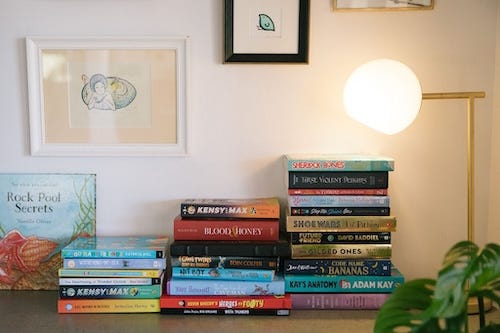
As parents and educators, we know that surrounding children with books is one of the simplest ways to nurture a love of reading. Spaces that make books accessible and inviting act as gentle nudges towards reading for pleasure. Having books in various nooks and crannies ensures that books are front and centre and always on hand, much like retail spaces that are designed to capture our attention.
In my own home, my children have enjoyed book-themed nooks, like reading tents, comfy reading chairs, cushioned zones and cubby houses at various stages of their lives. Decorating with the colours, characters, and motifs from our favourite books always felt like a natural choice as the design choices are made for you – simply draw upon the illustrators choice of colours, patterns and motifs.
When she was a toddler, my now thirteen-year-old daughter had a ‘Little Blue’ (Gaye Chapman) reading tent (complete with cushions in Willow patterned fabric) and the girls also had a shared reading nook on our sunny front deck made up of large floor cushions around a fairy garden we’d made (and lots and lots of fairy books).


I do love a themed reading nook at home and school, and in our school library Mrs Malta recently made the most gorgeous reading nook based on ‘Market Day’ (Carrie Gallasch, Hannah Sommerville).
In fact, Mrs Malta is the queen of the ever-changing reading nook and she is constantly changing up our spaces and creating little micro displays of books to capture the attention of our students. A micro display in a library refers to a small, focused collection of books or resources, usually arranged thematically or around a single concept, designed to quickly catch attention and encourage browsing and reading.
Unlike large displays that might take over an entire wall or table, micro displays are intentionally compact and targeted, often placed at high-traffic points like the ends of shelves, small tables, or counters. We have several lightweight couches in our school library and Mrs Malta is forever pushing those things into corners or back-to-back to create themed reading nooks.
Small Spaces, Big Impact
The beauty of reading nooks is that they don’t need to be large to be effective. A single cushion, a cosy blanket or rug, and a basket of books can transform an unused corner into a reading sanctuary.
As a first-year teacher, I turned a dark classroom corner into a riot of colour and ever-changing books for reading for pleasure with a second-hand shagpile rug, some hot pink tulle fabric and fairy lights. It was a magical space that my students and I brainstormed and created together, and they loved curling up in there with a book – I still think about that hot pink reading nook 25+ years on!
What made it so special was that the students were involved in the process. Children have a delightful habit of seeking out spaces that adults often overlook, they are natural explorers and often gravitate to spaces we least expect. Invite them into the design process by asking where they feel most comfortable reading.
In our school library we have a set of wide, carpeted stairs which, really, just act as an access point to adjoining classrooms. But we noticed how often children lounged all over these stairs at lunchtime, reading and chatting, creating a natural reading nook. So we have encouraged this use of the space by adding some small and easily moved coffee tables with magazines and other ‘quick reads’ for those students who race in at lunchtime and plonk themselves down on the carpeted stairs.
Function and Form
When designing spaces for reading, think about functionality first. Your budget, your child’s/students’ interests, and the purpose of the room will all play a part. Start with the essentials: storage, zones, and colour.
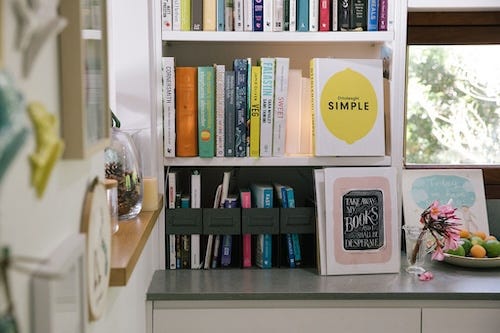
When it comes to designing a reading nook, storage is key. If you’re short on floor space, look up! One of my favourite tricks is using picture ledges at child-friendly heights. Ikea has a range of picture ledges for home use and there a so many picture shelves for school libraries from retailers such as Merchandising Libraries and RAECO.
There’s a reason retailers display items at eye level — it grabs attention. Books shown face-out allow children to connect immediately with covers, which are like mini posters. Spine-out shelving often leads to books being pulled off and left in messy piles, especially in high use areas like the Minecraft section in my school library! Displaying books front facing invites readers in and turns shelving into an ever-changing gallery of books.
For extra storage (and to help keep things tidy), consider adding baskets or boxes to your reading nooks. These are super easy to clean up quickly but also practical to flick through and again, and see the covers.
Choose colours for your reading nook that feel calm and inviting, or go bold with a palette inspired by favourite book covers. Add tactile elements — soft cushions, textured rugs, or even a soft bean bag chair — to make the nook a place where children are comfortable. Children are more likely to sustain voluntary reading when they feel physically comfortable.
Next consider atmosphere - lighting to create warmth, soft furnishings for comfort, and natural elements like plants to make the space feel alive. Even small touches like bunting made from book pages, book-themed cushions, or student-made artworks inspired by favourite stories add layers of meaning to the space.
Let your space evolve. Seasonal displays at home or school (my Christmas books are at the top of the linen cupboard until December each year!), student recommendations, and themed book zones keep the environment dynamic and engaging. Libraries that continually reinvent themselves show students that reading is not a static activity — it’s ever-changing and full of surprises (remember Mrs Malta and her micro displays!).
And while I can’t promise you a self-cleaning reading nook, a well-organised nook can encourage children to take ownership of their space. When books and cushions have a designated home, tidying up feels more manageable — and much less like a chore.
When we build reading spaces with intention — whether a reading nook in the lounge room, a cosy corner in a classroom, or an inviting display in the library — we build habits and most importantly, we build readers.
This post was created by Megan Daley, an award-winning teacher-librarian working in Brisbane, co-host of the Your Kid’s Next Read podcast, author of ‘The Beehive’ and editor of Teacher, Teacher. She is also a sought-after public speaker, literary judge and Artistic Director of Somerset Storyfest.