

Write the unexpected
Writing tips from top Australian children's authors – and how to use them for your young writers

If there’s one thing that writers love more than writing, it’s talking about writing – and, specifically, talking about writing to help other writers.
I am incredibly lucky that my career has combined both of these things for, well, let’s just say several decades. I began my writing career as a magazine journalist, learning the intertwined crafts of interviewing and features writing.
As my writing branched out into newspapers and online content, alongside my first forays into writing novels, I also began to dip my toes into podcasting, first for the So You Want To Be A Writer podcast, alongside co-host Valerie Khoo, and then, of course, into the Your Kid’s Next Read podcast, with my ride-or-die Megan Daley.
All of which is to say I’ve spent a lot of time writing, in one form or another, AND talking about writing, in one form or another.
So, with NAPLAN season underway, bringing with it its many, many discussions about reading and writing, I thought I would draw on both of those things to share some useful writing tips from five top Australian children’s authors.
These tips are all garnered either from interviews I’ve conducted with the author, or from articles the author has written for my blog. I’ve linked to the original source in each case so you find out more (and there’s often SO much more) if you’d like to.
For the most part, the authors were speaking with an audience of adult writers in mind, so I’m giving the tip, and then PRACTICAL ways you can action the tip with the young writers in your life, whether at home or at school.
But first, because I do so very much like talking about writing, I’m going to give you my number one tip for young writers…
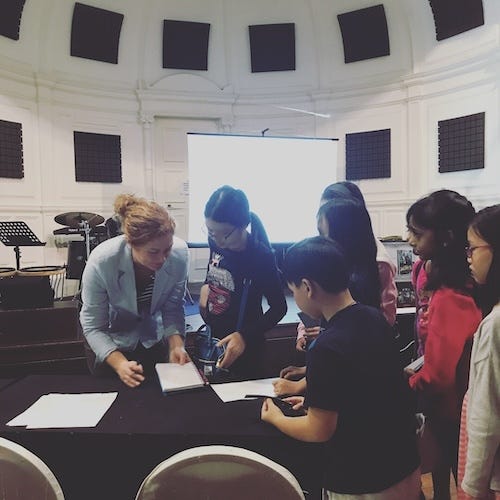
PUT IT ON THE PAGE
Put it on the page. It sounds simple but this is my number one piece of advice when giving feedback to countless young writers in my Kid’s Creative Writing Quest course. Why? Because kids immerse themselves in their stories, forgetting that the reader cannot see what’s going on in their minds.
They know why a character does something. They know what a room looks like. They know that dragons only eat fresh figs for breakfast (which is why the fig tree at the bottom of the garden is SO important and requires a full paragraph of description in an 800-word story).
But they forget that a reader is coming to their story cold, without the benefit of the movie playing in their heads. If a reader asks you ‘why?’ or ‘how?’ or ‘what?’, the writer won’t be standing beside them to tell them the rest of the story that’s shimmering in their mind (and I see this in action when I teach face-to-face workshops).
Make sure everything a reader needs to know is on the page for them.
(You can hear me talk about this in episode 148 of the Your Kid’s Next Read podcast, where I also share more of my favourite writing tips for kids)
A.L. Tait’s tip in action
The best way to show this tip in action is to try a ‘read like a writer’ exercise. Ask your young writer to choose a book that they know really well (so they won’t be distracted by a great story) and then READ THE FIRST CHAPTER, making notes along the way of exactly how their favourite author gives their readers all the details they need as the story unfolds.
•How do they use dialogue to share information?
•How do they build the description of the world into the action?
•How do they ensure a reader knows the character’s history without giving a big slab of information – do they give a big slab of information in an interesting way?
•Is the character described all at once or in bits and pieces?
The aim of the exercise is to see how published authors build a world and a character even as they’re building a story – and they give their readers everything they need to understand what’s going on, even if you don’t always know why yet.
After all, we need a reason to turn the page…
PUT THE TRUTH INTO YOUR LIE
“Telling stories is very similar to telling lies. And the best way to tell a lie is to make sure it is as close as possible to the truth.
The same goes for stories.
If you want your readers to keep turning those pages, then you need to make your story CONVINCING. And the way to achieve that is to pepper in as much TRUTH – specific details, authentic emotions – as you can in order to make your story, no matter how fantastical, CREDIBLE and BELIEVABLE.”
– Sue Whiting, author of numerous bestselling and award-winning books, from picture books to young adult novels (read more of Sue’s tips for writing a page-turning story here)
Sue Whiting’s tip in action
Sue’s tip is an excellent variation of the old writing adage ‘write what you know’.
Young writers often feel as though they need to reinvent the wheel every time they write a story, but the truth is that even the most imaginary fictional worlds need to be grounded in truth to create a connection with a reader.
And the best way for writers of any age to find all those ‘truths’ - experiences, feeling, random facts, curious thoughts – is to keep a journal.
It needn’t be a full-blown diary – just a record of one thing that the young writer saw, felt or thought that day.
I put some more tips about this in our downloadable 10-Day Creativity Challenge.
WRITE THE UNEXPECTED
“Always, always break narrative expectations, what the reader expects … the reader cannot know what is going to happen next.
You must have that tension as they turn the page. No one has ever turned pages to say, ‘oh isn't that lovely description, I'm going to turn the page to get more description’.
It has to be [about] what happens next. If they can predict what is happening, then you've failed as a writer.”
– Jackie French, author of 140+ books for children and adults (you can hear more of Jackie’s writing tips here, or read a transcript.)
Jackie French’s tip in action
Jackie is obviously pulling no punches in this tip, which is aimed at adult writers, but the idea of trying to surprise your writer is one that writers of all ages should aim for.
One way young writers can find ‘the unexpected’ is to push their ideas as far as they can.
I use an exercise in my writing classes called ‘good, better, best’, where we search for the best word for a sentence. Often the first word we come up with is ‘good’, the second is ‘better’ and the third is ‘best’ (and not necessarily the longest…)
The same exercise can be used when considering the plotting of a story. Often the first ‘ending’ we come up with is good – but expected. It’s not until we push a bit harder, trying some different ‘what if?’ ideas that we find the best solution.
I’ll use The Mapmaker Chronicles as an example.
When I set out to write a trilogy about a race to map the world, featuring Quinn, a boy who really didn’t want to go, the most predictable ending would have been for Quinn to overcome all his challenges and be rewarded with a win at the end.
But I knew as I wrote book one, that wasn’t going to happen. I wasn’t 100 per cent sure what WAS going to happen (because, to Allison Rushby’s everlasting horror, I do not plan my books) but I knew it needed to be unexpected.
The solution to what DID happen came out of two things – Quinn’s character (which always drives story for me, because every decision made in the story comes back to who Quinn is) and the cumulative effect of all of those other challenges along the way.
So what was the ending? Well, no spoilers, but let’s just say that everyone gets what they deserve…
Get your young writers to consider WHO their character is and WHAT their character wants, and then ask them to turn both of those things upside down and back to front to surprise their readers.
FINISH THE WORK
“Finish the work. I think that’s really important. Especially when you’re writing early drafts. That’s what works for me, finishing the work, even though I might think that that early draft is terrible. I can always revise it later.”
– Remy Lai, author of nine novels and graphic novels for junior and middle-grade readers (you can hear more of Remy’s writing tips here, or read a transcript)
Remy Lai’s tip in action
Getting to ‘The End’ is a Writing Superpower (and I say as much in my Find Your Writing Superpower presentation in schools).
You can have all the writing talent in the world, but if you never finish a story it’s hard to get top marks (or a publishing contract, if that’s your goal).
This one is simple enough to put into action. Challenge your young writers to finish.
Start by getting them to write a paragraph.
Then ask for a page.
Then ask for a story of 800 words.
Then ask for a longer story (if age-appropriate).
The only thing they have to do is to create a complete story – beginning, middle and end. It doesn’t have to be polished. It doesn’t have to be perfect.
It just has to be finished.
LEARN TO TAKE FEEDBACK
“Always be open to feedback, because there are two halves to a story. There’s what you think you’ve written and what somebody reads.
The whole point of being a good writer, it’s not about being verbose, it’s not about being clever. It’s about reducing the gap between what you think you’ve written and what people actually read.”
– Will Kostakis, award-winning author of numerous books, including seven acclaimed YA novels (you can hear more of Will’s writing tips here, and read a transcript)
Will Kostakis’s tip in action
When I talk to young writers, I am always careful to make the distinction between feedback and criticism. Writing is a personal business and I know just what it takes for a young person to share their work with someone else, so I try to be very careful with that.
The way I frame it is that if you given your writing to a trusted person – a teacher, a parent, a mentor – and they come back to you with questions, take note. It feeds back into the idea of ‘putting it on the page’.
If someone’s asking questions, they are letting you know that the information a reader needs is not there.
I let them know that published authors are not immune from these questions and that we have all learned, over a long time, that no story is perfect – particularly when it’s a first draft.
BUT I also suggest to young writers that they are clear upfront about what they are looking for when they ask for feedback.
Are you looking for ‘does this make sense?’ feedback, or are you asking for the grammar to be checked?
So one practical exercise in this area is to ask your young writer to give you three questions next time they hand in or pass on a story.
Three things they want you to pay particular attention to, whether it be the description, the solution, the dialogue, whatever.
It’s one way to get young writers to think about the story from a reader’s perspective.
LET IT GO
“Don't hold on to a story for too long. I know writers who tend to polish and polish and polish and they hold on to it. [My advice is to] just let it go.”
– Pip Harry, award-winning author of novels (for middle-grade and YA readers) and picture books (you can hear more of Pip’s writing tips or read a transcript here)
Pip Harry’s tip in action
Yes, I’ve said it before (see Learn To Take Feedback) but no story is perfect. But that won’t stop young writers from trying to make a story perfect – or hiding it in a drawer because they’re worried it’s NOT perfect.
The best thing that ever happened to my writing was deadlines. As a young journalist, I quickly learned that I did not have to write a ‘perfect’ story to be published. But I absolutely, one hundred per cent, had to make deadline. The most perfect story in the world was of no use to me if the magazine had gone to print without it.
So I learned to write the BEST POSSIBLE story I could – and then let it go.
When I began writing fiction, I gave myself deadlines to ensure that I would get the stories written.
Writers are impossibly insecure creatures and none of us is ever sure that what we’ve created is ‘good enough’.
But published writers have learned to do the very best they can, and then hand it over to someone else.
Or, as Belinda Murrell, author of 35+ books for young readers, told me in this blog post about ‘how to tell when your writing is good enough’:
“I am never sure that it’ s good enough which is why I love deadlines because at that point I just have to send it off!”
So give your young writers a deadline. After which, they have to let it go – and start writing another story.
This post was created for Your Kid’s Next Read by Allison Tait.
Writing as A.L. Tait, Allison is the author of three epic adventure fantasy series for readers 9+: THE MAPMAKER CHRONICLES, THE ATEBAN CIPHER, and THE MAVEN & REEVE MYSTERIES.
Her first contemporary middle-grade novel THE FIRST SUMMER OF CALLIE McGEE is out now. Find out more here.
WILLOW BRIGHT’S SECRET PLOT is coming on 1 May 2025.
For more writing tips for kids aged 9-14, check out Allison’s Creative Writing Quest for Kids, an online course to help develop their skills and confidence.